Go with a smile!

Sunday, March 06, 2011

5 10 15 20

They have this wonderful feature on pitchfork, where they invite a musician to talk about the music that they were listening in 5 year intervals of their life. Well I’m a musician, even though I’m not the kind of musician they’d invite to give talks on pitchfork (at least not yet). But that sounds like a great idea for a blog entry.

5 years old.

I would say that most of the music that filtered to my consciousness at that age was 70s disco. Probably one of the strongest early memories was ABBA, and my father was a fan. Other things that I must have picked up at that time were the Saturday Night Fever soundtrack, the Brothers Gibb, etc etc. Considering how easily I took to 70s funk later on in life, it probably made a great impression on me. That was also the year when I started music lessons.


10 years old.

Not much happening to me music wise that year, although that was when I passed my grade 5. I was probably listening to more classical music, because my music teacher (erroneously in my opinion) believed that pop music was a bad influence. I really liked: Beethoven’s moonlight sonata, his 5th symphony, a lot of Chopin etudes, his Fantasie Impromptu.

That was the 80s. I remember that Europe’s “Final Countdown” was a big hit that year.

People in Singapore have this attitude, probably fostered in colonial times, that art is some luxury that is patronized by the upper class. As opposed to something that makes your soul complete, as opposed to something that’s all around you, that tells you something about your own life. A pretty fucked up attitude, I would say. It took me a long time to see beyond that.

15 years old
That was the year my ears were opened to a lot of music that was pouring out due to the “Alternative music” revolution. That was the year I went on a music binge: I discovered Bowie, The Clash, Public Enemy, Bruce Springsteen, Jimi Hendrix, kd Lang, REM, Nirvana, Teenage Fanclub, Meat Beat Manifesto, Pink Floyd, Suzanne Vega, World Party, Matthew Sweet, Sly Stone, Peter Gabriel, Sonic Youth, Red Hot Chilli Peppers, Faith No More.

I couldn’t believe my ears when I heard Public Enemy for the first time. There was so much density going on in their records, and they were doing all sorts of tricks: feedback, bleeps, noise, spoken clips, “YEEEEHHH BOYEEEEE”. I probably didn’t fully understand that it was also a soundtrack to – let’s say – people of a fairly disadvantaged background, but it’s hard to understand how their lives could be so wretched if there was so much great music going on.

At the same time, there was the white mirror image of the Clash, the most socially conscious punk band. Yes, the recording quality was tinny, you couldn’t make out the words from the thick cockney. But the accent was totally authentic to me. They were such adventurous people too, moving from punk to reggae to funk, yet always sounding distinctively themselves. Plus they were also fantastic songwriters, who came up with such catchy anthems. How Jones and Strummer is not mentioned alongside the Brill Building greats is somewhat beyond me.

20 years old
The music of the late 90s was also a wonderful time. Lots of great rap records were made then, although I only knew about them later. Electronica, punk, Jungle, alternative and rap. And some other artists who used all those as colours on a palette. Beck, Bjork, Portishead, Massive Attack, Tricky, Prodigy, the Chemical Brothers and Goldie were making music that were basically uncategorisable.

But it was also a time for me to be discovering older classic music. I got acquainted with T Rex through “The Slider”. He made such wonderful 3 minute pop. I found Northern Soul through Dexy’s “Don’t Stand Me Down”. I bought my copy of “Bitches Brew” that year if I remember correctly.

25 years old
In the interim, I had discovered a lot of jazz music when studying overseas. I marveled at the compositions of Jobim, the experiments of Charles Mingus. But I found my real musical soulmate in Thelonious Monk, who understood the architecture of awkward silences.

That year, though, I listened a lot to Bill Evan’s “Sunday at the Village Vanguard”. It was a wonderfully tranquil record, with so much going on under the glossy sheen of “easy listening” music. Listening to how he played was like watching the reflection of the moon on the ripples of a lake, and all those little explosions of light.

30 years old
It was a quiet time for me musically. I had sworn off buying records. I think I discovered Scott Walker around that time. I first became acquainted to the Walker Brothers when I bought their compilation on a whim. Fantastic voice. I liked the strings he put on Pulp’s “We Love Life”. But I was quite unprepared for what I found on “Nite Flights” and “Tilt”.

This was the year, I think, that I started cranking out music on a regular basis. I had just downloaded a freeware that allowed you to make short MIDI clips, something really shitty quality. But it enabled me to write down a lot of music that I held in my head previously, and I was able to write a few songs that year. It was a good year, if every year I wrote as many songs and they were as good as what I came up with that year I would be very happy.

Playing your own music to yourself is a little like popping your own cherry. Writing music without producing it, but keeping yourself amused by listening to it over and over again is the music equivalent of masturbation.

Labels:

0 Comments:

Sunday, February 27, 2011

Death of the printed book.

It was bound to happen one day. There is news that Borders is filing for bankruptcy.

I grew up in a Singapore where a lot of good books were not available. I remember going for a talk, and the lecturer bemoaning the fact that Singaporeans never managed to get a lot of books from the stores. In those days, we had Times, we had MPH, and not much else.

And it’s strange to think that, for those years, since – this will surprise a lot of you – I wasn’t a bookworm in school, I got a lot of my knowledge from school books. Which means curriculum planning forms the basis of so much of my knowledge.

The arrival of Tower Records was a big thing in Singapore, even though, as we now know, Tower lasted only slightly more than 10 years. Those things were the big triumph of American capitalism. My teenage years of getting my ears opened to music took place in the last few years before the internet year 0. When I visited England in the early 1990s, I was amazed at all the used book stores in that place. There were an incredible range and variety of books on topics that I never ever knew existed. I went into Virgin megastore as a – so to speak – virgin. I left as a not so virgin.

Those were the days when there were a lot of books and records that I heard were very good, but were never available in the stores. Television’s “Marquee Moon”. Miles Davis’ “Bitches Brew”. Big Star’s “Third”. If and when you did find them, there was this amazement that that piece of treasure was in your hands, then you realised that it would cost you 1 week’s pocket money. Well I suppose you just had to save up.

I read an interview of LCD Soundsystem, where the guy said that he lived through this. (he’s 5-10 years older than me). I know about it. The legends that grow around certain records. The music would inevitably be good, but no matter how good, it would be a let down. In fact, while you were being deprived of it, you had to imagine what it sounded like. I can also trace my development as a composer to the fact that I sometimes had to wonder what the music sounded like, before I heard it.

In this way, I read about accounts of what Jimi Hendrix’s music was like before I heard it. The same was true for Captain Beefheart and Television.

In fact, in a way I feel sorry for the younger kids, who never had to deal with that type of deprivation. They never knew what it was like to go to a bookstore, read magazines about rock music, get seduced by all the lurid descriptions of how wonderful this or that music is like. It’s like from young, you only get to watch hardcore porn, and you don’t know what it’s like to have a fully clothed by nice looking girl slowly seduce you over a long period of time. They don’t get to go through the human mating ritual.

Like I said, Tower coming to Singapore was a big thing. Things changed in a big way. I never had to endure a lot of that deprivation anymore. MPH knew about Tower records, and they tried to steal a march. They refurbished the Stamford road building, and there was a “megastore” called Music Power House. I thought it was dumb that they wanted to rename Malaysian Publishing House as something else, until I realised that MPH was itself renamed from its original moniker of Methodist Publishing House.

The ethos of a megastore: there were a few factors. First, you needed to have a fancy and nice looking layout. Everything had to look more sexy than your drab Times the bookstore. You needed to have fantastic piles of books, and seduce people through sheer volume and variety. The message: you would never need to go anywhere else to shop for books. Second, you needed to produce a very homely environment, where people felt comfortable hanging out for hours at a go. Some people don’t mind drab warehouses with cobwebs everywhere. But others wanted the smell of expensive gourmet coffee in the air, nice sofas for you to rest.

Then, there was price. The megastores would be able to get new releases at lower prices than the other independent stores. I think a lot of other independent stores got killed as a result. And for most of the other books, they could price them higher because you are paying a premium for being able to walk into one store and get all the books that you want.

Then, there were the events. You would have book signings (not that common in Singapore, actually). You would have the book launches, of which Harry Potter were the most infamous. There was this time when I saw enough copies of “Order of the Golden Phoenix” to fill a 20 footer.

I wish I had taken pictures of megastores, I didn’t know that they were doomed. 2 years ago, I visited 2 megastores, in San Francisco and Denver. I didn’t know that this would be the last I would ever see of them. I should have taken pictures but I didn’t. Within 1 year, they were finished.

Ultimately, then, what is killing the megastores? I think the megastores are a very temporary and artificial environment. If you think about it, the thing that made them flourish is also the thing that kills them in the end. At first, there was no internet. They were superior because they and they alone had access to all the computer databases. They alone had access to all that knowledge about where all the good books were and where to find them.

In the second stage, everybody had the internet. Then it was even more a boon for them, because everybody had greater access to a wider range of books. Consumers being more well informed is on the whole a good thing because there is a lot of desire for books that didn’t really exist before. I think that the internet fuelled the rise of the megastores, because it released a whole load of pent-up demand for books that didn’t really exist previously.

There were other things, such as computer aided publishing making books a whole lot more presentable. You just try reading some books that were published in the 80s, before LaTeX came along. You would have shoddy looking footnotes. Maybe not so great looking indices. I think that a lot of the books in the age of the word processor have 10-20% of their length taken up by footnotes. That is incredible – hints of material that wouldn’t make it onto the actual book itself is such a large percentage of the total.

The cover picture looks tacky unless a skilful graphic designer was involved. LaTeX was responsible more for textbook porn than anything else, and was probably responsible for some peoples’ decision to go get a PhD. Yes, all because they make mathematics equations look fantastic when printed out.

There were other things: after I had read a book, I would google the name of the book, and read what some other people said about the book. That book itself would not be the be all and end all of a certain form of knowledge. I would then understand if the book was biased in a certain way, or if the author had certain predispositions towards certain viewpoints. I would read all the countervailing arguments. It was like reading a second book on top of the first, and it was massively helpful for me.

The classic example of a book that didn’t come with all the internet commentaries attached, was of course the Bible. If people in those times got to read all the semi-edited version of the Bible, a lot of the reverence for that book as a supernatural thing would have been lost, you might wonder if Christianity would ever have gotten off the ground.

However the internet brought along with it a lot of threats. First, book reading as a hobby would be threatened by the great availability of stuff on the net. Second, you had competition from Amazon.com. Third, you had competition from ebay.

The first indicator I got that Borders was on the way out – something that I should have known but didn’t – is the MPH warehouse sale. You had a lot of books that you didn’t manage to sell. And many books – they have a shelf life. The pages get yellow. Those books about current affairs will all clearly be outdated within 2-3 years – barely enough time for people to read it. Even history books – people always prefer history books to be based on the “latest research” but I wonder if that really makes it better. Novels – I don’t know why people have so much reverence towards “classic” novels of the 19th century, and books that were written 10-20 years ago are all written off, even the more “literary” ones.

Whatever it is, for a physical book, it would be extremely difficult to plan inventory. There are university courses all about planning inventory. A lot of people use statistical functions to predict demand. That sounds extremely laughable! If a book is a blockbuster, versus if it were a bust – as though it’s like a normal distribution, what kind of weed were those professors smoking?

The second indicator was Borders itself. It used to be such a pristine place. In the first year, people would treat that place with reverence. America was the most powerful country in the world, and it was like getting invited to the American way of life. You never saw so many books in your life. You just felt that you would read and read forever. I certainly felt that way, but soon after I left for a place that was actually in America and had no Borders until I was almost to leave that place.

Towards the end, the arrangements of the books became more sloppy. All the good books are bought up, and what’s left are the embarrassing extravagances. The quality of the material on display always goes down. People will look at a lot of the books in the bargain bin and start to wonder, “who ever thought of publishing a book like this?” or “this is such an obscure niche”. As hard as it is to plan inventory for the big blockbusters, planning for inventory further down the long tail is even more, devilishly difficult.

The third indicator was my own bookshelf. People discovering Borders for the first time would normally just grab a lot of books. I didn’t. I grabbed a lot of books from the warehouse sale instead. And as time goes by, the books you have on your shelf are much less sexy than when you first bought them. I’m sure that a lot of married men feel the same way about their wives. I just have a whole shelf full of books, and I don’t really know what to do with them. Some of them are going to be expired.

That’s when it occurred to me that Borders is sitting on a time bomb. A lot of their customers are the naïve buyers. After a while their poor Singaporean rooms will be filled up and there will be no more buying of books. The great enduring mystery of Singapore is why is shopping is the national past time when Singaporean homes are too small to accommodate that much merchandise. Eating makes more sense because you know what happens to the food in the end. And say what you want about the casinos, at least they strip you without taking away your living space.

Borders is predicated on the premise that people would want to spend a small fortune on a nice book. To be sure, books are really nice things. Even with the advent of backlit plasma screens, ink on paper is still the best. Kindle might close the gap, but nobody knows. But when it comes to information, packaging something like that in something that looks like a brick is somewhat arbitrary. Information is not meant to be packaged. It is not meant to be stocked up. Maybe as an artwork, the novel makes more sense. As a non-fiction book, the periodical makes more sense. The textbook, which attempts to give you a broad survey of closely related intellectual material makes sense. A non-fiction book, which is somewhat like a novel?

OK, the book would be fine for me in this regard: somebody takes the time and effort to take a lot of information and refine it into something higher and more valuable. There is a lot of value in the process of putting things together. Issues are rendered on a deeper level and you can see the deeper underlying patterns, rather than if you were to just read a whole load of blog articles / magazine articles. The analysis is better. But what if it’s a book that I didn’t really want, or a book that I only intend to read a small part of?

Then what you have is a lot of books taking up a lot of space. The package that the book comes in lasts much longer than the validity of the information. Yes, it’s a good thing that we got to learn a lot about the Sumerians based on what they wrote on their clay bricks. But there are too many books in this world.

Non fiction books make more sense if they are packaged in bits instead of atoms. That way you would never have to decide what is the inventory level. You only have to decide how to price them. Information works better as a flow. You should have to stop selling the books when you run out of physical books. You should only stop selling them when the information they contain becomes invalid.

The other thing, paper books are not really searchable. They have tried to circumvent the problem using the index. If and when eBooks becomes the default medium, you shouldn’t even had an index, except maybe to indicate when a concept is the main part of a certain passage, or when it is only mentioned in passing.

Also for the consumer, eBooks is also useful: I don’t want to learn everything in a book. I just want to look it up. I may not want to read it, ever. I don’t want a clunky volume taking up space in my room if I don’t need it. I’m careful about what I buy but I still end up getting my house flooded in all that stuff.

Information also wants to be free. There’s so much to be learnt from the random blog post, the breaking news on the internet, the commentary, and talking to people. The information is demand driven, wrested out by the interested person. Rather than you just have to read this book chapter because that is what some author somewhere a few years ago presumed that you would read. And it might not be everything there is to know because so much has to be held back / censored / redacted in order to satisfy editorial / journalistic / censorship board standards. If a book is written for the general audience, it means that it was written for somebody other than you, and you would also have to share it.

And with the death of the printed book, I think also about a way of life. I used to spend hours hanging out at megastores, whether for CDs or for books. I realise that this is not something people a generation older or a generation younger would do. When I’m browsing a bookstore, I would serendipiditiously come across something else that I like. That’s what I looked forward to while browsing bookshops. That’s why I was such a committed bookworm for about 7 years – there was always something to discover. The entire sensory experience, people all walking around you, colourful covers, and when you shut them all out, the random engrossing book chapter. Also finding the random interesting book, was like bumping into an interesting stranger. When you’re surfing alone it’s a much lonelier experience.

Then the last thing was the serene and happy hours promised by the first flush of the internet. The dream was that you would just put your money in internet stocks, they would do all the work for you. And then you would spend the rest of your leisurely life sipping lattes, reading for leisure, maybe discovering good music, cinema, surfing for interesting stuff.

No, the internet has taken away a lot of our job security. Taken away a lot of certainties in life. It’s hard to be a rich man these days without working your socks off. Poor and rich alike have to slog away. Most people will create new and wonderful things that nobody will ever buy. That is the new economy, and it’s very sad.

Labels: ,

0 Comments:

Friday, September 24, 2010

Timbaland

Just realised that there is an unusually high concentration of Timbaland produced albums amongst those that I have bought in bargain bins recently. It's testimony to his production genius that he is responsible for so much of the stand out music of the last 10, 15 years. And it is also testimony to the disposable nature of the music industry that such fine albums should find their way to the bargain bin. (OK, none of them are stone cold masterpieces but plenty of fine stuff nevertheless.

Timbaland and Magoo – Welcome to Our World
Missy Elliott – So Addictive
Missy Elliott – Under Constructiion
Missy Elliott – Da Real World
Justin Timberlake – FutureSex / LoveSounds
Ginuwine – 100% Ginuwine
Aaliyah (RIP) – One in a Million
Jay-Z – Vol 2 Hard Knock Life

I could have had one more: I was mulling whether to buy Nelly Furtado's "Loose" then decided against it.

Labels:

0 Comments:

Thursday, September 02, 2010

The nineties in music

I think, if you were to make a list of the greatest albums of the 90s, there are a few things we can all agree on.

Loveless – My Bloody Valentine
OK Computer – Radiohead
Blue Lines – Massive Attack
Fear of a Black Planet – Public Enemy
Parklife – Blur
One from Spiderland – Slint, Laughing Stock – Talk Talk
Maxinquaye – Tricky
Dummy – Portishead
Screamadelica – Primal Scream
Homogenic – Bjork
Illmatic – Nas
Something from Jay-Z / Notorious BIG
Nevermind – Nirvana
Automatic for the People – REM
Millions Now Living Will Never Die – Tortoise
One from Liquid Swords – GZA, Only Built for Cuban Lynx – Raekwon
Chronic – Dr Dre
Deserter’s Songs - Mercury Rev
Soft Bulletin – Flaming Lips
Different Class - Pulp
Something from Yo La Tengo
Something from Pavement
Odelay – Beck
Something by Wilco


I’m quite sure that in any list of the top albums of the 90s, you can find the majority of these albums. There is a consensus of what the greatest albums of the 90s were. Either I wasn't around to observe what the most important albums were, or there wasn't a consensus.

Something strange happened, though. You would notice that most of these albums listed above are before 1998. After that, the internet became really big, and music journalism was in the hands of more than just a few print journals. Maybe it was that everybody was talking so loudly that there was no consensus.

Anyway I had been following Pitchfork's feature of the best songs of the 90s. I like it that they finally had a policy of not featuring more than 1 song from the same artiste.

I posted this here just before they revealed the top 20. Here are a list of artistes who have not been on the list yet. Wonder

Radiohead
Nirvana
My Bloody Valentine
Stone Roses?
Weezer
Pulp
Neutral Milk Hotel
Pavement
Belle Sebastian

I actually think the 90s were a great time for music. It's hard to supplant the 60s as the golden decade for music, but the 90s were up there with the 70s. There was a lot of good music in the 80s but a lot of it was 90s. In the 90s, there were great forces unleashed by the emergence of the underground, by a media which loomed larger in people's lives, by new forms of music which had yet to be fully explored: alternative rock, grunge and rap. By the way that more people than ever before had access to recording equipment. By the way that the internet changed social networking and music distribution.

Much of what was good about that decade did not lie in the emotional impact of the songs: most of the stuff couldn't match early Tin Pan Alley, classical music, or the best of the showtunes. But it was made up for in the complexity of arrangements (if you can call all those postmodernist collages "arrangements") and the freshness of different styles of music bumping and grinding against each other creating unexpected orgasms.

Edit: all of my predictions, other than the Stone Roses who released their stuff in 1989, made the list. Some of the things I forgot, like Pulp or DJ Shadow or Snoop Dogg. But in lists like this, the top 20 are fairly obvious, although I'm a little sore at the list for putting "Being Boring" by the Pet Shop Boys down at 100+ position.

Labels:

0 Comments:

Sunday, June 13, 2010

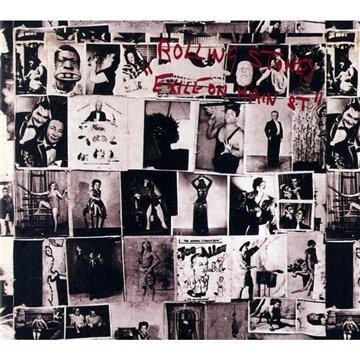
Exile on Main Street


For some reason they’re re-mastering “Exile” now and not at some major anniversary of 1972. “Exile” is my favourite Stones album, and the last and greatest of their acknowledged masterpieces. (The other 3 being “Beggar’s Banquet” – which lent its name to a record label, “Let it Bleed” and “Sticky Fingers”). They ruled the roost in the immediate wake of 1970, as though the demise of their rivals, the Beatles, energized them and allowed them the freedom to fulfill their billing as the “best band in the world”.

Some aspects of the album have passed into legend. They fled Britain to escape paying hefty taxes, so they really were tax exiles. They moved to a mansion at the south of France. The recording sessions were rowdy and decadent, and probably very disorganized, this probably was reflected in the music. This was the beginning of Keith Richard’s long-standing heroin habit. That would probably reflect itself in the Stones’ spotty output over the subsequent course of their career (but they were probably also creatively exhausted as well). Gram Parsons, another very talented smackhead was around at the sessions, jamming around with them. Probably he overstayed his welcome – in any case, Mick Jagger was keeping a close watch on him, wondering if Gram Parsons was going to supplant him as Keith Richard’s main creative partner. No danger of that, though – he died of an overdose a few years later.

I found this album on a cassette when I was 16. I had heard a lot about that album so I bought it. I was not impressed. It sounded quite ordinary and murky. I think that was the reaction of a lot of people who listened to it for the first time, because the general critical reaction to the album was that people were vaguely disappointed with it. Later on, though, small bits and pieces caught on through the sonic sludge, and today it’s far and away my favourite Rolling Stones album (second favourite is “Let it Bleed”, but that one is a distant second). If you were to ask most people to name their favourite, it would most probably be “Exile” as well.

There weren’t any outstanding singles on “Exile”. No “Sympathy for the Devil”, no “No Expectations”, no “Gimme Danger” or “Brown Sugar”. So why is this their best album? Because – and this is probably a concept foreign to the iPod generation – albums are evaluated as a whole, and in spite of this being one of their their longest albums, it is also the most cohesive.

“Exile” was called a double album because you needed 2 LPs to fit everything on, even though later on everything could fit onto 1 CD. Typically double albums are a grab bag of varied artistic styles, and it is the traditional symbol of the artist expanding his horizons. On the good side, it is probably a reflection that this is a fertile stage of the artist’s development, because otherwise he doesn’t have that much stuff to work with. On the bad side, maybe he really doesn’t have that much stuff, and a lot of it is filler. A lot of the left field ideas come up, and sometimes the work lacks thematic consistency, sometimes the quality is uneven. As usual, the Beatles have managed to make the definitive double album – their white album. Just as white is a mixture of all colours, that was, for better or worse, 4 solo projects cobbled into one.

But then again, double albums have this great advantage in that there’s always more quantity, it always has more ideas bouncing off each other, and the sheer novelty of much of the material will usually offset the lack of coherence. Size does matter. Everything else being equal, the lady with the bigger tits wins.

Somehow, “Exile” managed to have the best of both worlds. It’s extremely rich in different styles and musical ideas, and yet everything hangs together. Everything looks like it’s of a piece. The cover photograph conveys this perfectly. It’s a pastiche of a lot of photographs. Some of them are of freaks, some of them are gypsies, some of them are of perfectly ordinary people. No one detail stands out from the background. Yet because this is a black and white rendering, everything is filtered through the same lens. Everything looks of a piece, everything looks like it belongs together.

This album did not have a picture of a toilet bowl on the cover (“Beggar’s Banquet”), did not misappropriate the title of a Beatles’ album (“Let It Bleed”), and did not have an Andy Warhol picture of a crotch in tight jeans (“Sticky Fingers”). It wasn’t calculated to shock or offend. Those 3 albums had their gems but always included 1 or 2 awkward songs that made me want to press the skip button. There are no such songs on “Exile”.

I liked “Exile” the best because it felt the most natural of all the Stones’ albums. The informal setting of the French villa came through there, and there’s this feeling they’re right there in front of you, in your bedroom, playing that music in their pajamas. “Exile” is your favourite pair of shoes, not the most stylish or expensive, but the most comfortable and most lived in.

I don’t know if the Stones were also stressed out about their situation. There was plenty to fret about. A few years before, a fan was murdered in one of their concerts. Brian Jones was dead. They weren’t able to make music in London. They probably had pretty squalid surroundings. Maybe they weren’t thinking that much about making loud and bold statements, which was why they just wrote a lot of unassuming songs about real life. I always felt that this was their most emotionally real album, that I was hearing the real Rolling Stones, rather than the ones that felt that they had to make shocking stuff like “Bitch”, or “Sympathy for the Devil” or “Midnight Rambler”.

There were songs about gambling. There were songs about sin and redemption. There were straight out rockers, there were piano ballads, and gospel choirs. Rock and roll, country, the blues, and all of it was blended into this thick rich soup, where you no longer knew what belonged to what. All the songs here have titles, but when they pop into my head, it’s not as an individual piece, I just think, “this is an Exile song”.

I don’t know if they have done something as unpretentious as this. Much of this music, one realizes, could only be made by a band at the height of their powers, and yet they seem utterly relaxed. Maybe some of them were too distracted by the turmoil going on that they just got much less self-conscious when making the music. Perhaps I'm only saying this in hindsight, that it seems like the end of a long plateau, that this is a band that's cruising on their experience and enjoying the fruits of the hard work of the previous years.

Maybe they should have broken up right after that. But then again, this is also the band of Keith Richards, one of the toughest people around, who should have died a long time ago, but remains inexplicably alive.

A review of this album noted that this is more of Keith Richard's album, because it's more in his wild and rambling style rather than in the Mick Jagger calculated to shock / offend mode. (He even gets to sing on a couple of songs). No wonder Mick Jagger should look at it many years later and stuffily declare that he doesn't understand what the fuss is about. I've always preferred Keith Richards over Mick Jagger.

Labels:

0 Comments:

Sunday, May 30, 2010

CDs

They invented the CD in 1982, and at that time they said that it was going to be the gold standard for audio fidelity. The CD was a joint invention with Sony and Philips. When determining the length of a CD, the chairman of Sony decided: make it long enough for the entirety of Beethoven’s ninth to be fitted onto it. Beethoven’s 9th is 60+ minutes, so they made the length 73 minutes.

Since then, there had been a few other attempts to replace the CD. There had been the digital compact cassette and the minidisk in the 90s. I think they had super audio CDs and DVDs and stuff like that.

The CD had proven to be a durable medium. There were concerns that CDs, being an optical medium, could only be played a few thousand times before it expired. That did not happen to any of my CDs so far, but I better play some of my older CDs to double check. What is not durable are CD players. Because the CD revolves a few hundred times a minute, it is inevitable that the motor wears out quickly.

There were some people upset about the CD when it came out. There was a nostalgia for vinyl records, and then cassettes. I bought a lot of cassettes as a kid, and I could not afford CDs on a schoolboy’s pocket money. I think CDs cost almost 3 times as much as a cassette. That’s why sieteocho does not really understand it when people tell him he’s a rich kid – he understands poverty, really.

CDs were seen as the ultimate end point for all music technology. In a way this was true. It was the first form of music storage that was digital in nature. It was also possible, in that way, to jack up the prices of CDs to be extremely expensive. I think they cost twice as much as vinyls. The record industry probably saw the CD as their ticket to even greater profits. The earliest CDs were sold as $33. When you considered that cassettes were going at around $6 or $7, that was extortionate.

We moved to my present home around 1990, and we bought a hi fi set. It was also around the time that I started listening to pop music. They asked us which CDs we wanted to buy. I decided on Phil Collins’ “But Seriously”. (My sister was a fan of “Another Day in Paradise”, which she considered a “meaningful song”.) And we also bought “Milli Vanilli”. Eventually we saw Phil Collins for what he really was – a balding nerd – and I sold off that CD. I hope we kept that Milli Vanilli CD as a souvenir – it wasn’t even the actual CD, but a remix – but I don’t seem to be able to find it.

It was also the beginning of my being a music freak. The next 5 years were the high point of my love affair with music. But as said, I bought cassettes. Unfortunately, cassettes wear out eventually, no matter how well you keep them. And the tropical weather in Singapore is singularly unsuitable for cassettes, because the damp damages the oxide layer.

Around the time when I was in JC, cassettes became less and less common. As my tastes were somewhat different from mass produced commercial music, the music I wanted to obtain was to a large extent not available on cassettes. (They only manufactures cassettes of the bestsellers in Singapore, which means atrocities like Ace of Bace and Michael Learns to Rock.) I bought BIGO magazine on a regular basis, because they opened to me a world of music that wasn’t available to myself just by looking at your typical HDB retail outlets.

At the same time, this was around the time of Nirvana, who was at the vanguard of a revolution in a music industry – the “Alternative” music revolution. Consumers want choice. They don’t want to listen to your Bon Jovis and your Cunts and Roses because everybody wants to listen to them. I differentiated myself from my peers through my music.

I also got a lot of my music from mainstream magazines. By reading through them in a lot of bookstores without every buying them. (I repeat – I understand the meaning of poverty very well). You may wonder how this is possible. Well, in the good old days, when Times the Bookshop was king, they used to have more standing room around the magazine racks than they do today. Nowadays reading print magazines is not possible, nor is it necessary because you have the internet. Through them, I was able to learn about all the major bands in classic rock and all that stuff.

Another reason for me to buy CDs, therefore, were the classic rock albums. To be sure, there were plenty of stuff available on tape. But the rest, I had to go and look for the CDs. This meant the Smiths albums, 1 or 2 Bob Dylans, almost all the Joni Mitchells and all the David Bowies (except for the greatest hits).

Around that time, there were 2 mega stores in Singapore – Tower and HMV, and they made a great variety of music available to Singaporeans. Before they came, the major stores were Da Da at Funan (now closed – thankfully. Thankfully because although that place was a big favourite of magazine writers and bored children of rich kids with plenty of pocket money, the guy was not friendly to schoolkids. However credit must be given in that when most local bands release music, they can count of him to help distribute it.) Also there were other places like Chua Joo Huat, Supreme Music Centre and Sembawang. MPH used to be a music retailer for a while. They turned the Stamford branch into a nice big megastore with a music section called “Music Power House”. But when they tore down the National Library MPH had to close down. Somebody who worked there told me that the whole operation was losing money anyway. For me I liked Sembawang and MPH best because they had some of the lowest prices. So those were the main places I bought CDs from.

I was spending embarrassing amount of time combing my way through CD racks the same way that blue whales comb the ocean for plankton.

There were some rare albums which you could never find. I suppose that all just added to the mystique of those rare albums. It was a let down when you actually found those albums, but never an outright disappointment. There was always something special about those which justified the hype.

When HMV opened in 1997, I found a lot of CDs I had looked for but never found. I think that was a year I spent a few hundred dollars on CDs. I just wanted to grab a lot of stuff before the last copy was gone, and you couldn’t find it again. I didn’t want to order it through the shop because I didn’t want to fork out a few more dollars.

I think that was the last time I was so extravagant on CDs. Because the next year I went to the States. And 1998 was the first year I had heard of MP3s. (It was also the first year I had heard of the Ethernet connection.) And I don’t have to tell you, an obscene amount of music goes through networks of college dorms. Napster was coded in a college dorm, so that does tell you something.

That was the year that the internet changed everything in the music industry. Brian Eno said that there was a certain time when whale blubber was the most precious commodity in the world because it was the main source of fuel before we discovered fossil fuels. Likewise the music industry will realise that it has lived in a unique day and age when it was able to monopolise the production of music, and leverage on the incredible demand for music to make shitloads of money, and it will realise that this era is over and might not start again soon. This was the era when it was possible to become incredibly rich by being a rock star, when it was possible to just quit performing in public, retire to the studio, and concentrate on your recorded output, just like the Beatles and Brian Wilson did. But no more.

Everything changed, and they sowed the seeds of their own destruction when they introduced CDs, because that was the moment when digital copies of music became widely available. The only developments that remained were the means to copy, store and transmit the information. That didn’t happen until 15 years later but it was basically inevitable.

To cut a long story short, records suddenly became very much cheaper for me. Some obscure titles in the US were a few dollars cheaper brand new than they were in Singapore. I built up almost the entirety of my jazz collection while in the States. I used online retailers like Music Boulevard and CDNOW. I think the first is now defunct and the second has been co-opted into amazon.

I think, somewhere in my 2nd or 3rd year, I decided to purge my record collection, because it was going out of control. I listed more than 200 CDs for sale, and managed to sell all of them in a matter of weeks. If you think that my ebay feedback score of 500+ is fantastic, just imagine that at the end of 2 months it was already close to 200.

Those who were lucky enough to have stepped into the Tower records branch when it was still open in mid 90s will know what it’s like to be confronted with the sheer variety of music being presented. I think that was what the music market in the US was like at that time. I don’t really know because I don’t remember seeing more than a small fraction of it at any one time.

I also signed up for a music club. You had to buy CDs from them on a regular basis, and you could get them at US$6 each on average, although the range is rather limited. But I still managed to get quite a few gems from them, like really cheap boxed sets: Velvet Underground, Steely Dan, Galaxie 500.

After a while I just stopped buying CDs new. I will still do so nowadays if the price is right, but most of the time I either get them second hand, or I got them from the music clubs. Shelling out S$20 for a new CD was an old nightmare I wasn’t keen to revisit. And of course there was piracy. I had to put my hand up and declare that I downloaded a lot of stuff.

But a lot of it was more stealthy. Every CD I sold, I ripped it first, and then I shipped it out. So I still kept the music, even though I didn’t have the CD anymore. That’s probably not legal. But the boundary is very grey.

I still remember the trip back in Singapore when I decided to throw away all my cassettes. I think it was a wrenching decision, because I had come to love so much of the music that was on those cassettes. But all that music was replaceable. I got back much of that music through eBay. The rest, I downloaded, which is sorda legal because when you buy the music, you are entitled to own the MP3.

Do I regret buying the cassette first and then the CD? No. Because a lot of my cassettes were not replaced. There were a lot of impulse buys that were just filtered out like that.

Anyway it was incredible for me, because all that music that used to be so expensive for me is now so cheap. Except that the time spent listening to all that music turned out to be the expensive component instead.

When I went back to Singapore, I shipped all my CDs back (except for the few I very charitably left with my sis – after getting a digital copy for myself, I suppose.) In Singapore it’s mostly been the same trick. Buy CDs cheap. If you really like the CD, you keep it. Otherwise, you try to sell it and rip it off first before you let it go.

There were a few sad episodes in Singapore. As you know, land prices in Singapore went up very high from the 90s onwards. So CD shops became less and less viable. Mostly they became more and more concentrated in large megastores. Even a few megastores had to close. I’ve written about the sad fate of some megastores elsewhere.

But fortunately being sad doesn’t mean I can’t capitalise. I did. There were places that were having great sales of CDs for around $10 each. I think they just wanted to empty all the warehouses. I got a lot of good stuff from those places. There was this big space at Shaw Towers (the Beach Road one) where they used to sell a lot of CDs for $10 each. I was mystified as to how they undercut people so much. Anyway I didn’t care, I just decided to load up. Buy, rip sell. Then the MP3s are yours for the difference. Which is less than $10. Within 2 years, that store was gone.

Owing to the growing unfashionable-ness of CDs, I think the used CD markets are quite good now. People actually getting rid of plenty of good stuff at good prices. Whereas it used to be a seller’s market in the first 7 years of eBay’s existence, it’s now a buyer’s market. If you can stand the thought of CDs getting a layer of dust at home, it’s not a bad way to acquire music. Don’t bother looking for something specific. Something good or interesting will turn up.

A great CD retailer passed on last year. I was buying stuff at Sembawang as a teenager when it was really at Sembawang. Yes, as in get on the bus at McRitchie and take the half an hour ride all the way up north. Then after that they started opening branches every where, there had to be one in every other suburban shopping mall. And suddenly they were kaput. I made up for not buying new music for 7 years (during that time I bought mostly oldies) and instead I went on a rampage and plundered their closing down sales. Spent a few hundred on, say 100 CDs. Had a few choices I regret must mostly it was good.

Then lately I found that the Gramophone shop on St Andrew’s Road will usually have a few CDs that I wish I had the money to buy when I was a teenager. Well, I grabbed them. Then there’s cash converter. If you don’t mind the grimy environment, if you don’t mind the fact that it’s mostly patronised by lower class HDB folk, you might find that even people with left field tastes in music either run out of money or run out of space to store their CDs. Plenty of Take That’s, InSyncs, Boyzones. The odd David Gray or Fatboy Slim here and there. Even a few REMs, Chemical Brothers, Trickys, Massive Attacks and U2s.

But you have to be careful there because they accept all sorts of trash. In fact as of now, I am kicking myself because I bought what I thought was a Prodigy album. They even allowed me to inspect the CD before you fork out the money. Usually you overlook a few scratches, a few cracks on the CD case. But the CD inside was a heavy metal CD and I didn’t realise it until I got it back home! No big loss for me, because the CDs there are like $10 for 5. But I’m still unhappy. Well at least being able to buy another 40 CDs is a nice consolation.

If I should find myself being able to get records from the US again, I think it will be incredible. There’s a lot of new music I’ve not kept up with for the last 10 years, and a lot of it will be available to me at ridiculously low prices. A lot of people point the finger at piracy for crippling the music industry. That may be true. But there are more important factors at work, like a fantastic second hand market and the fact that consumers have such a wide choice of music to choose from that nobody really wants to pump money into developing an artist for fear of making mistake.

PS: if ppl are wondering why there aren’t any more ridiculously rich musicians around anymore, I think you should know why after reading all this. There’s no reason to be a musician at all. No reason other than love.

Labels:

0 Comments: